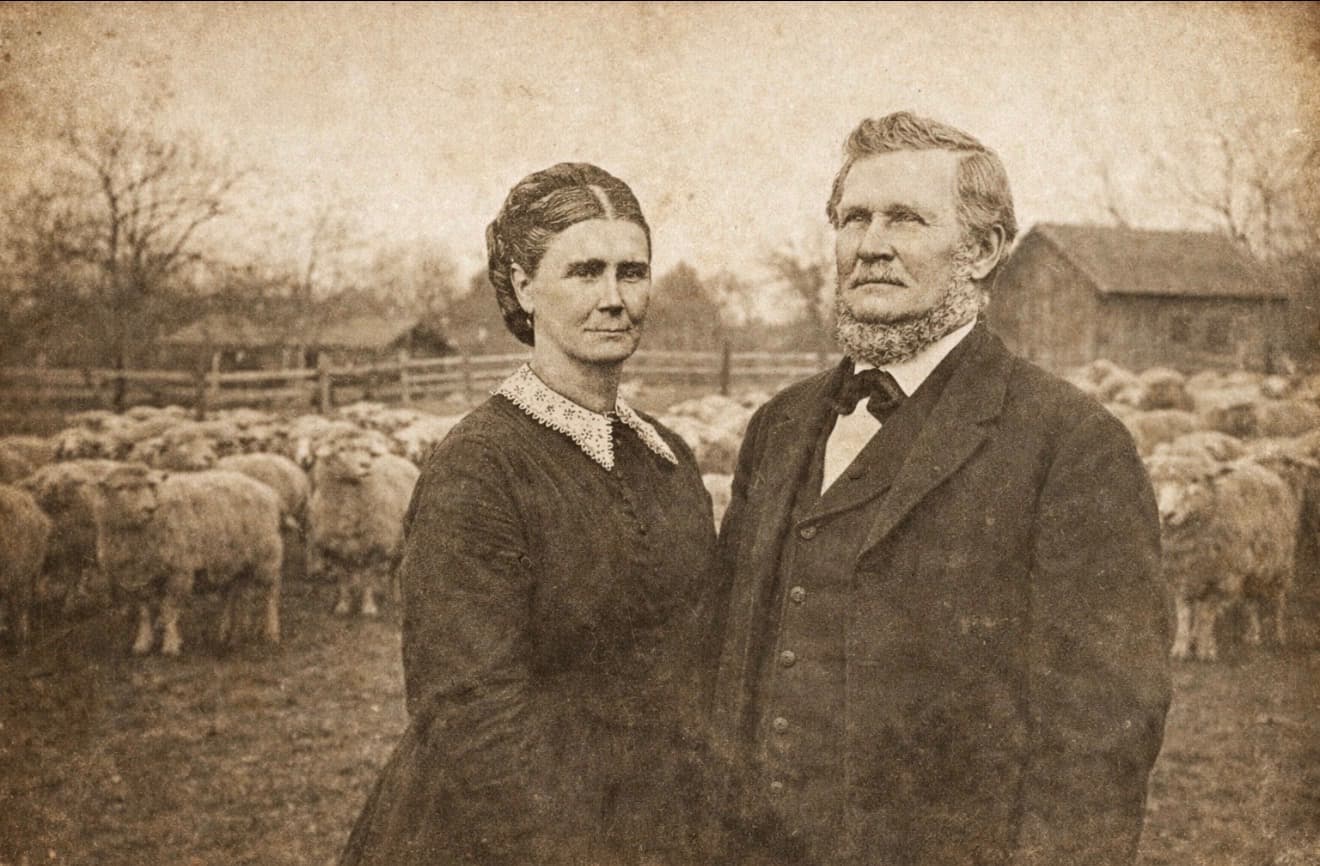

The Story of the Loomis Homestead
The History Behind Stag’s Leap Farm Bed & Breakfast
Long before it became Stag’s Leap Farm Bed & Breakfast, the land beneath our home was part of one of the earliest settled homesteads in Brandon Township, Michigan. The story begins nearly two centuries ago with a pioneering family whose roots helped shape the local community.
The First Settlers
In 1836, Thomas Noble Loomis purchased 420 acres of government land in what is now Brandon Township in Oakland County. Like many early settlers of the time, Loomis was both ambitious and practical. On this land he constructed a substantial log house — described in historical accounts as a “pretentious log house, chinked and fitted with a Dutch chimney.”
A Dutch chimney in the mid-1800s would have been an impressive feature. Typically made of distinctive Dutch brick, it formed a large central structure that could support multiple fireplaces throughout the home — an important source of warmth during Michigan winters.
In the spring of 1837, Thomas brought his family to the property, establishing what would become one of the early homesteads of the township. Just two years later, on October 1, 1839, his son Oscar D. Loomis was born on the farm itself.
Even earlier, in 1837, the Loomis family welcomed their daughter Emily, who is said to have been the first white child born in Brandon Township. The homestead quickly became a cornerstone of the local community.
Farming, Sheep, and Public Service
Thomas Loomis was more than just a farmer. He became an influential figure in the township’s early development. In 1845, he introduced Spanish merino sheep to the area — an important step that stimulated Brandon Township’s sheep industry and encouraged improvements in local flocks.
He also played an active role in civic life. Loomis served as Overseer of the Poor in 1837, and from 1843 through the Civil War era, he frequently held the role of Supervisor of Brandon Township. His leadership and agricultural innovation helped shape the township during its formative years.
The Loomis Family Legacy
Thomas and his wife Julia Miller Loomis raised several children on the homestead, including Jacob, Franklin, and Oscar, who all worked the farm as they grew up.
As the family expanded, the brothers built homes on inherited land nearby. One of those homes — built by Franklin Loomis — still stands today at the southeast corner of Shipman and North Baldwin Roads, bearing a striking resemblance to the Victorian gabled style seen at Stag’s Leap Farm today.
Oscar Loomis eventually followed in his father’s footsteps and also served as Supervisor of Brandon Township, continuing the family’s tradition of civic involvement.
From Homestead Roots to the Governor’s Office
The Loomis family legacy didn’t just shape Brandon Township — it eventually reached the governor’s office in Lansing.
One branch of the Loomis family line connects directly to Murray Delos Van Wagoner, who served as Michigan’s 38th Governor from 1941–1943.
The connection begins with Jacob L. Loomis, one of the sons who grew up working the original Loomis homestead farm. Jacob and his wife Esther Cole raised their family in the area, including their daughter Florence Loomis.
Florence later married James Van Wagoner, and their son — Murray Van Wagoner — would go on to become one of Michigan’s most prominent political leaders of the 20th century.
Before becoming governor, Van Wagoner served as chairman of the Oakland County Road Commission, where he became known for modernizing transportation infrastructure and improving Michigan’s road systems. In 1940 he was elected governor of Michigan and served from 1941–1943, guiding the state during the early years of World War II.
For visitors staying at Stag’s Leap Farm, it’s fascinating to think that the story of this quiet homestead — once a frontier farm carved out of wilderness — connects to a family lineage that eventually reached the highest office in the state.
The Loomis–Van Wagoner Family Line
Thomas N. Loomis (1807–1879)
m. Julia Miller
Early settler of Brandon Township, 1836
└─ Jacob L. Loomis (1824–1907)
Farmer and early community leader
m. Esther Cole
└─ Florence Loomis (c.1860–1931)
m. James Van Wagoner
└─ Murray Van Wagoner (1898–1986)
38th Governor of Michigan
Served 1941–1943
A Century of Loomis Ownership
For more than 100 years, the Loomis family maintained ownership of the land in Section 12 of Brandon Township. That era came to an end in 1942, when the final Loomis descendants sold the property to Floyd Carleton, a local farmer.
Over the decades that followed, the property passed through several owners, each leaving their mark on the home and land.
A Timeline of the Property
- 1836 – Thomas Noble Loomis purchases 420 acres and establishes the homestead
- 1867 – Oscar Loomis acquires 160 acres of the property
- 1942 – Sold to farmer Floyd Carleton
- 1965 – Purchased by Leslie Lueck, President of Parke-Davis Pharmaceuticals, who added decorative plaster arches, curved ceilings, and cherry woodwork
- Late 1970s – Property divided into parcels as the original farm was reduced in size
- 1986 – Purchased by Edward Beaudet, who renovated the house, leveled floors, expanded the kitchen, and even added a golf hole on the property
- 2012 – Purchased by Christopher Bork
- 2018 – Purchased by Joshua Maly
- 2019 – The property begins its newest chapter as Stag’s Leap Farm Bed & Breakfast
The Next Chapter: Stag’s Leap Farm
Today, the historic Loomis homestead lives on as Stag’s Leap Farm Bed & Breakfast. While the home has evolved through nearly two centuries of ownership, the spirit of the land remains the same — welcoming visitors, celebrating community, and preserving a small piece of Michigan history.
When guests stay at Stag’s Leap Farm, they aren’t just visiting a bed and breakfast — they’re stepping into a story that began in 1836, when a pioneering family carved a homestead out of the Michigan wilderness. And like all great homesteads, the story continues to grow.